Why Is The Sky Blue?

Trent's physics class discussed this topic earlier this week. Trent told his physics teacher that I have a particular fondness for this question. I've spent time helping out at the school. Earlier this year, I came into the class to do some pendulum experiments. We measured the gravitational constant with pendulums and stopwatches. So, Trent's teacher contacted me to see if I had anything I wanted to contribute. It's true, I've thought a lot about sky color. It's one of my favorite science questions because it feels like the answer should be simple. The correct answer is – it's complicated.
As soon as younger me came across the words Rayleigh Scattering, I – I'll admit it – smugly said those words whenever sky color came up. Did I know what they meant? I assumed that it was a physics thing. Did I read anything about it? No. Saying some words I didn't really understand was no better an explanation than 'because'. It's worse – because of the smugness.
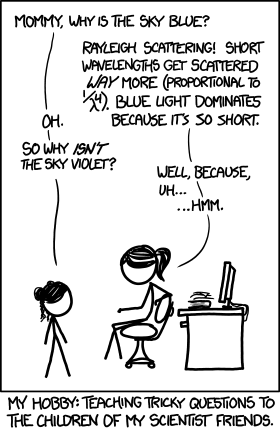
I was eventually prodded out of my complacency when I read this Randall Munroe xkcd cartoon.
Rayleigh Scattering is a thing that happens when electromagnetic waves – like light – encounter the atoms in the atmosphere. When electromagnetic waves pass by, they affect atoms like ocean waves affect a boat. On an ocean, the boat goes up and down as the waves pass and the movement makes the boat's passengers – think electrons – nauseous. They get sick over the side. Moving electrons up and down is how electromagnetic waves are made. Electrons affected by light waves emit light instead of their lunch. So is that all there is to it? No, it's more complicated than that.
The boat analogy gestures at why the atoms scatter light, but why isn't the sky just the same color as the sun? We know from prisms that the sun has all the colors of light, right? We'll return to this question, but for now, let's say it does. The insight of Rayleigh Scattering is that waves with smaller wavelengths scatter more than waves with longer wavelengths when passing through a cloud of particles. You've probably noticed that when you hear music from another room, the lower frequency bass is easier to hear than the higher pitches of the human voice. It's similar with light. Red light is like the bass you can hear through the walls, while blue light is like the treble bouncing off the drywall. If we could see the high-pitched sounds, they'd be bouncing around the room with the speakers. We can see the blue light bouncing around in the upper atmosphere.
We've made progress – but still, the little girl in the Munroe cartoon asked why the sky isn't violet. Violet light has even shorter wavelengths than blue light. Shouldn't it scatter even more than the blue light? Why isn't the sky purple? If you researched black body radiation, you know that the sun produces less violet light than blue light. The atmosphere does scatter more of the available violet light than the available blue light. There's just less violet light. So, is that why it's not purple? It's part of it, but it's more complicated – brace yourself if you're a fan of purple.
There's a line in Tom Stoppard's play, Rosencrantz and Guildenstern Are Dead, spoken by one of the titular characters – I don't remember which one. He says, "The colours red, blue and green are real. The colour yellow is a mystical experience shared by everybody." This statement reflects a peculiar truth about human perception. Humans perceive color using nerve structures called cones that are sensitive to red, green and blue light. There are no cones that detect yellow or purple.
You may be remembering a time when you saw something yellow or purple. You did. It's even the case that light can be yellow and purple (violet). But the sensors in your eyes don't detect those colors of light very well. Yellow and purple are something that happens in the human brain when it sees red and green or blue and red. In terms of human perception, yellow and purple are a mystical experience shared by everybody. Why isn't the sky violet? The violet light scattering in the atmosphere is violet light, not a combination of red and blue light. If it were blue and red light, the sky would be purple. The human eye doesn't see violet light very well. So, you just see the blue light.
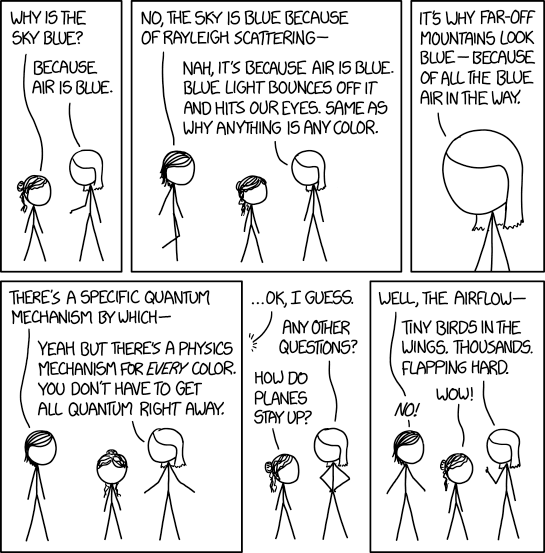
Why is the sky blue? Because of the color of the sun, the way the atmosphere reflects light, and the way the human eye works. Is it more complicated than that? It always is. I'm comfortable with this level of detail. You may feel differently. If you want to understand more, explore black body radiation, the quantum effects of electromagnetic waves on electrons, neural chemistry or human perception. Is it alright to think of sky color in a less complicated way? Sure. I'll leave you with the answer I recommend for general use. In some ways, this is the best answer I've found. Five years after the first cartoon that started my journey, Munroe followed up with this.
Member discussion